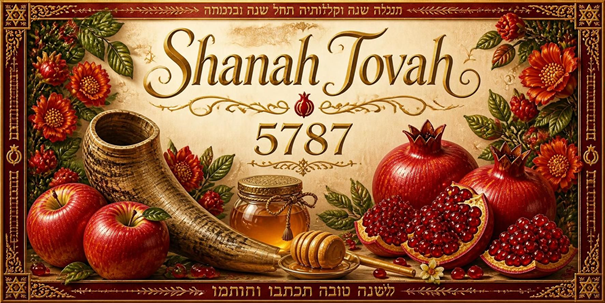
September 2026 – Tishrei 5787
Introduction by Steve Chappell – HLM board member U.K.
This October 7th will see the third anniversary of the worst atrocity against the Jewish people since the Holocaust.
For three years Israel has been fighting a battle for survival on multiple fronts. We can be grateful that recently life has returned to a more normal rhythm. Only last week the Israeli government opened all schools in Israel ending three years of constant disruption for Israel’s schoolchildren.
However, the situation remains challenging politically and militarily with the IDF still engaged in multiple areas.
The people, land and nation of Israel still need our heartfelt prayer and support during this continued struggle and not just in Israel as anti-semitism is growing across the developed world.
The imminent autumn moedim (appointed times of the LORD) of Rosh Hashanah (Feast of Trumpets), Yom Kippur (Day of Atonement), Sukkot (Feast of Tabernacles) and Shmini Atzeret) bring with them prophetic hope.
Rosh Hashanah will be celebrated in Israel this year starting on the evening of 11th September 2026.
For us as believers in Messiah Yeshua these appointed times have an even greater significance because they prophetically proclaim His triumphant return and the inauguration of His Kingdom here on earth.
We know from our LORD’s own words that times of great trial will precede His return. In the middle of His discourse on the signs preceding His return He states in Matthew 24:14 “This gospel of the kingdom shall be preached in the whole world as a testimony to all the nations, and then the end will come.”
This is why at HLM we have a sense of urgency in the mission the LORD has called us to which is to spread the light and love of Messiah wherever, whenever and however we can.
Please pray for HLM, our team of workers and volunteers that the LORD would guide direct and anoint each one that the message of salvation in Messiah Yeshua would find open and effective doors of ministry and that we will see all those we minister experience the joy of God’s salvation in Messiah Yeshua.
We are pleased to be able to include the following article on the Autumn Moedim by our local Rabbi and dear brother in Messiah Yeshua.

המועדים בסתיו תשפ״ז
The Appointed Days of the Fall 5787
The month of Tishrei is an important month on the Biblical calendar. In this month there are a total of four special holidays. The month begins with the Feast of Trumpets, commonly referred to as Rosh HaShanah. It is followed by the Day of Atonement, the Feast of Tabernacles, and then finally, a most unusual day called the Eighth Day Assembly (Shimini Atzeret). Each of these appointed days has a special message attached to it, which is incumbent upon every believer to learn, in order to understand the revelation of G-d to His people.
Let us begin with the Feast of Trumpets. The horn which is actually sounded on this holiday is the Shofar, the ram’s horn. On this day, the account of the binding of Isaac is read in the synagogue. What is significant is that Abraham is commanded to offer up his son, his only son, Isaac as a burnt offering. It is most interesting that in fact Isaac was not Abraham’s only son, as Ishmael was also his son. The important thing is that it is only Isaac who is connected to the promise of G-d. As Paul states in Galatians 3:16,
τω δε αβρααμ ερρηθησαν αι επαγγελιαι και τω σπερματι αυτου ου λεγει και τοις σπερμασιν ως επι πολλων αλλ ως εφ ενος και τω σπερματι σου ος εστιν χριστος
“But to Abraham the promises were made to be spoken and to his seed, it does not say and to the seeds, as to many, but as to one and your seed which is Messiah.”
Galatians 3:16
This verse shows the connection between the Messiah and Isaac. It was Isaac who was related to the promise, just as the Messiah is related to the promise of Salvation. When one hears the sounding of the shofar, it conveys to the listener G-d’s faithfulness to provide. In actuality the word which appears is not “to provide”; but rather in the Hebrew language it is simply the Hebrew word יִרְאֶה which means that the L-rd will see. It is most disappointing that instead of translating the word correctly, translators wilfully misrepresent the word and state that “the L-rd will provide”. The Hebrew text emphasizes that G-d is constantly watching His servants, and whenever there is a shortage, G-d will see and give to His people. Again, the emphasis is on G-d watching or seeing; rather than providing. It is unfortunately a good example of how translators interpret, rather than simply translate what actually appears in the Biblical text. In addition to G-d Who will see His people, there is also another verse of great significance in Genesis chapter 22. This verse is Genesis 22:17.
Once again, translators fail in doing their task. The Hebrew text states,
כִּֽי־בָרֵ֣ךְ אֲבָרֶכְךָ֗ וְהַרְבָּ֨ה אַרְבֶּ֤ה אֶֽת־זַרְעֲךָ֙ כְּכוֹכְבֵ֣י הַשָּׁמַ֔יִם וְכַח֕וֹל אֲשֶׁ֖ר עַל־שְׂפַ֣ת הַיָּ֑ם וְיִרַ֣שׁ זַרְעֲךָ֔ אֵ֖ת שַׁ֥עַר אֹיְבָֽיו׃
“For I will utterly bless you and I will utterly multiply your seed as the stars of the heavens, and as the sand which is upon the shore of the sea, and your seed will possess the gate of his enemies.” Genesis 22:17
Please note how several of the translators render this verse:
I will surely bless you and make your descendants as numerous as the stars in the sky and as the sand on the seashore. Your descendants will take possession of the cities of their enemies,
I will certainly bless you. I will multiply your descendants beyond number, like the stars in the sky and the sand on the seashore. Your descendants will conquer the cities of their enemies.
“I will bless you and give you such a large family, that someday your descendants will be more numerous than the stars in the sky or the grains of sand along the seashore. They will defeat their enemies and take over the cities where their enemies live.
I will certainly bless you and make your descendants as numerous as the stars in the sky and the grains of sand on the seashore. Your descendants will take possession of their enemies’ cities.
Brenton Septuagint Translation
surely blessing I will bless thee, and multiplying I will multiply thy seed as the stars of heaven, and as the sand which is by the shore of the sea, and thy seed shall inherit the cities of their enemies.
All of these translations fail, as they ignore the Biblical word שַׁ֥עַר and instead render it as “cities”. Such translations do not capture that the gate of a city is where judgment is administered. In other words, G-d is acting to judge the enemies of Israel. This is not an isolated incident, but exactly what believers should expect in the End Times. This also provides assistance in understanding the promise which comes through Isaac and the Messiah. The phrase “to possess the gate of one’s enemies” relates to victory. This is what G-d is promising to His people.
Now, we will move on to discussing the Day of Atonement. For those who embrace Reform Theology, i.e., Calvinism, there is a serious problem. One of John Calvin’s principles relates to the doctrine which states that what the Messiah provided for His people is a Limited Atonement. I would suggest that to speak of the Messiah’s work on the Cross as a Limited Atonement is highly insulting to G-d. One should never use the word atonement in regard to what our Messiah secured for the believer. He certainly was not crucified on the Day of Atonement, but rather on Passover, which is the day which is related to redemption. An excellent verse which underscores this fact is found in Hebrews 9:12,
ουδε δι αιματος τραγων και μοσχων δια δε του ιδιου αιματος εισηλθεν εφαπαξ εις τα αγια αιωνιαν λυτρωσιν ευραμενος
“But not through the blood of goats and calves, but through His own blood He entered once and for all, into the Holy place having cause to be found eternal redemption.”
Hebrews 9:12
Please notice that the Greek word at the end of the verse is ευραμενος. It is in the passive voice and shows that eternal redemption did not just happen, but “was made or caused to take place”. The source of this eternal redemption was of course the blood of our Messiah. Again, there is no reason to speak of the Messiah’s work as an atonement. There is also a most misleading verse which fails to recognise the Koine Greek language correctly. The verse is 1 John 2:2,
και αυτος ιλασμος εστιν περι των αμαρτιων ημων ου περι των ημετερων δε μονον αλλα και περι ολου του κοσμου
The vast majority of English translations render the Greek word ιλασμος as atonement. Such a translation is most problematic. If one properly researches the word, it becomes clear that such a sacrifice is not at all related to an atonement. Among better translations the word is rendered as propitiation. This word only appears twice in the entire New Covenant, here in 1 John 2:2 and also in 1 John 4:10. Let us examine these two verses carefully.
και αυτος ιλασμος εστιν περι των αμαρτιων ημων ου περι των ημετερων δε μονον αλλα και περι ολου του κοσμου
“And He is the propitiation concerning our sin, but not concerning ours only, but also concerning the whole world.” 1 John 2:2
There is nothing contained in this verse which would support a Calvinistic teaching of a limited atonement. Again, it is highly offensive to G-d and our Savior to speak of Messiah’s work on the cross as an atonement. Atonement is only a covering and is temporary in nature. Messiah was crucified on Passover, the Day of Redemption, and His blood purchases for the believer eternal redemption.
εν τουτω εστιν η αγαπη ουχ οτι ημεις ηγαπησαμεν τον θεον αλλ οτι αυτος ηγαπησεν ημας και απεστειλεν τον υιον αυτου ιλασμον περι των αμαρτιων ημων
“In this is the love, not that we have loved G-d, but because He has loved us and sent His Son a propitiation concerning our sins. 1 John 4:10
In one word study aid it is stated about the word ιλασμος,
“of Christ’s blood that appeases God’s wrath, on all confessed sin.” By the sacrifice of Himself, Jesus Christ provided the ultimate ιλασμος hilasmós (“propitiation”). It is incorrect to speak of Messiah’s work on the Cross in terms of an atonement. However, what is said in this word study aid is accurate in stating, “Christ’s blood appeases God’s wrath, “By the sacrifice of Himself, Jesus Christ provided the ultimate ιλασμος hilasmós (“propitiation”).” What does the English word propitiation mean? When searching on-line I found this,
“Propitiation is the act of appeasing or averting the wrath of an offended party, especially a deity, to regain their favor. It involves making amends or offering a sacrifice to satisfy justice and pacify anger.”
When stating, “to regain favor”, it sounds most similar to reconciliation. This is indeed what redemption does; it reconciles the sinner to the Holy G-d. This reconciliation is not temporal or limited in any way. It is permanent and eternal. How does one know this? When a person accepts the Gospel, what does he or she receive? The answer is eternal life. There is great significance in the term “eternal life”. It means exactly what it says, the believer will live forever due to one’s faith in the all-sufficient sacrifice of Messiah Yeshua. The primary idea found in the word propitiation is the concept of appeasing or averting the wrath of G-d. If the work of the Messiah was limited in any way, one could not describe His sacrifice as a propitiation. Because of the blood of our Passover sacrifice, believers will never experience the wrath of G-d. There is nothing limited about this absolute and complete forgiveness! At this time, we will proceed to discussing the Feast of Tabernacles. The primary commandment is to dwell in temporary structures called booths or huts. Biblically, one is required to spend all seven days of the festival dwelling in these temporary dwelling places. Obviously, one does not have to spend seven full days, but normally sleeping and eating in this booth or hut is considered as dwelling in them. The main teaching of the Feast of Tabernacles is to trust, depend and rely upon G-d for all things. The Children of Israel were commanded to dwell in these temporary structures, so they would remember the faithfulness of G-d and that it was proper to trust Him for all things, that one could depend upon Him and never be disappointed and that He was fully reliable regardless of one’s circumstances. Another commandment which is connected to the Feast of Tabernacles involves taking the four species of vegetation. These four species are the etrog, the palm branch, the leaves from the myrtle tree and the leaves from a willow branch. G-d commanded the Children of Israel to not only take these four species, but to wave them in six directions, proclaiming the grace of G-d to the nations. This is related to G-d’s call upon the Children of Israel to be a light to the nations. The first day of the Feast of Tabernacles is treated as a Holy Proclamation. The rest of the seven days are part of the Festival, but work may be done on these days.
The final appointed day does not have a great deal of information written about it in the Bible. I am speaking about the Eighth Day Assembly (שמיני עצרת). We read about this day in Leviticus 23:39 and Nehemiah 8:18,
אַ֡ךְ בַּחֲמִשָּׁה֩ עָשָׂ֨ר י֜וֹם לַחֹ֣דֶשׁ הַשְּׁבִיעִ֗י בְּאׇסְפְּכֶם֙ אֶת־תְּבוּאַ֣ת הָאָ֔רֶץ תָּחֹ֥גּוּ אֶת־חַג־יְהֹוָ֖ה שִׁבְעַ֣ת יָמִ֑ים בַּיּ֤וֹם הָֽרִאשׁוֹן֙ שַׁבָּת֔וֹן וּבַיּ֥וֹם הַשְּׁמִינִ֖י שַׁבָּתֽוֹן׃
“But on the 15th day of the seventh month when you gather the produce of the land, you will celebrate the Feast of the L-rd seven days and on the first day a sacred Shabbat, and on the eighth day a sacred Shabbat.” Leviticus 23:39
וַיִּקְרָא בְּסֵפֶר תּוֹרַת הָאֱלֹהִים, יוֹם בְּיוֹם–מִן-הַיּוֹם הָרִאשׁוֹן, עַד הַיּוֹם הָאַחֲרוֹן; וַיַּעֲשׂוּ-חָג שִׁבְעַת יָמִים, וּבַיּוֹם הַשְּׁמִינִי עֲצֶרֶת כַּמִּשְׁפָּט
״And he read in the book of the Law of G-d, daily, from the first day until the last day, and they will do seven days and on the eighth day an assembly according to the judgment.” Nehemiah 8:18
The Eighth Day Assembly is understood by its name. The number eight is most important in the Scripture. It is connected to the concepts of “new”, “redemption” and the “Kingdom”. For it was on the eighth day that male boys were circumcised and entered into a new relationship with the Children of Israel. This concept of newness relates to the death of the flesh, the primary message of circumcision. Circumcision is not directly connected to the Torah, but to the Abrahamic Covenant which Abraham entered into by faith. It is faith and not works which brought about the death of the flesh. How is the number eight related to redemption? The Messiah was raised from the dead on the eighth day; that is seven days plus one, as the first day of the week is also known as the eighth day. It was on the eighth day that the work of Messiah was completed, when G-d His Father raised Him from the dead, testifying that G-d had received Yeshua’s work of redemption. It is resurrection that testifies to the victory which redemption brings about. What type of victory? A kingdom victory– as flesh and blood cannot inherit the Kingdom of G-d. The concept of the Kingdom speaks about a restoration back to the will of G-d. Only through redemption does the believer have an expectation that the will of G-d can now become a reality for him or her.
In conclusion, these Appointed Days of the L-rd provides the believer with an expectation that the enemy will not succeed in his plans against the will of G-d, and that through faith, what G-d has desired for His New Covenant people will be achieved.
Outreach to the Elderly in Ashqelon, Beersheva and Haifa
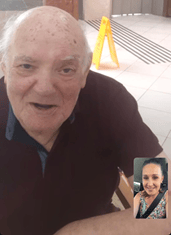
There was a significant answer to prayer recently. You may remember our long time wards David and Galina from Ashqelon. Galina was placed in a nursing home after her dementia became unmanageable for David who had devotedly cared for his wife in her illness. Galina recently died leaving David alone. David’s health also declined and he was admitted into hospital a short while ago.
Outreach efforts to assist the elderly and needy in Ashqelon, Beesheva and Haifa continue in spite of the current difficult situation and continuing elevated temperatures.
David was moved and his carer and friend of HLM, Ira, could not find out where he had been moved to. But last week she informed us that she had “tracked him down” to a care home in Jaffa.
We hope to establish contact again with David, who with his wife were always grateful for the support they received from HLM and looked forward to the visits of HLM staff.
Please pray that contact will be re-established and that David, and all our wards, would open their hearts to the message of salvation and come to saving faith in their Messiah Yeshua.
HLM Partners in India
Our work in India continues through our dedicated partner, Pastor Chandra.
He faithfully sends monthly reports of the charitable outreach he has been able to do with the help of HLM>
I include below the last report more or less in Pastor Chandra‘s own words.
”Shalom Dear Sister Julia and Thank you so much to the Holy Land Ministry -Israel.
This is the tzadecha (charity) report for the month of Elul and I am sending some pictures of the children.
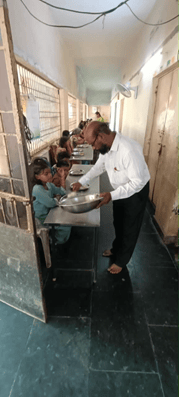
Today, I had the privilege of visiting Zion Blind and Orphans School and providing lunch for the children and physically challenged students there.
I went with the desire simply to serve a meal, but I came back with something much greater—a deeply moved heart and a renewed understanding of Elohim’s love.
As I looked at the blind children and the physically challenged children, my heart was touched beyond words. Some of them cannot see with their physical eyes, yet I felt that many of them were teaching me to see with the eyes of the heart.
Their lives reminded me that every human being is precious in the sight of our Creator. They are not forgotten. They are not less valuable. They are precious children created in the image of Elohim.
Yeshua HaMashiach taught us:
“Whatever you did for one of the least of these brothers and sisters of mine, you did for Me.” – Matthew 25:40
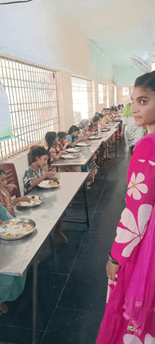
When we served the children today, I felt that we were not merely giving food to children—we were serving Yeshua Himself.
The lunch we provided may have been a small offering in our hands, but I believe that when it is given with genuine love, compassion and humility, Elohim can multiply its blessing.
Today I learned something very important:
Sometimes we think we are going to bless someone, but Elohim sends us there so that they can bless us.
These precious children touched my heart deeply. Their smiles, their innocence and their courage will remain in my heart.
I sincerely thank every member of Holy Land Ministries who stands with us in prayer, love and support.
May our congregation continue to be a community that does not only speak about God’s love, but shows Elohim’s love through our hands, our time, our compassion and our actions.
Let us remember the words of Isaiah concerning the fast that is pleasing to Elohim:
“Is it not to share your bread with the hungry and to bring the poor who are cast out to your house?” – Isaiah 58:7
May the Holy One, blessed be He, give us a heart like Yeshua—a heart that sees the suffering, feels the pain, and responds with love.
May our hearts carry those who are struggling.
And may every small act of kindness become light in someone’s darkness.
With a grateful and humbled heart, I thank Elohim for giving me this opportunity to serve these precious children today.
Toda Rabah.
Shalom and Elohim’s abundant blessings to you all.
“Let us not love with words or speech, but with actions and in truth.”
— 1 John 3:18
Blessings in Yeshua 🌸💗🌸
Bro.Chandra,
India.“
HLM ”Light of the Messiah“ Project in Batumi (Georgia)
Please see the article below from Anton, our dear brother in Messiah Yeshua and committed worker with HLM in Batumi, Georgia (formerly part of the Soviet Union).
“Nadezhda, Who Refuses to Lose Hope
Batumi, Georgia
It was raining that day. Not heavily—just the usual Batumi drizzle that gradually soaks your clothes and makes you look for a warmer place.
My brother in Christ, Garry, and I were standing near Nadezhda’s house, waiting for her. Suddenly she appeared from around the corner, wearing a simple floral dress. She was walking fast, almost like a teenager. There was something remarkably light about her. Modest, neat, elegant, energetic. There was absolutely no sense that we were standing before a woman who had been carrying the weight of war, forced displacement, uncertainty, and loss for several years.
She did not look at all like someone waiting for the whole world to start feeling sorry for her. Her name is Nadezhda [which means Hope in Russian]. After our meeting, I thought that it would probably be hard to come up with a more fitting name for her. Nadezhda is 68 years old and comes from Kharkiv, Ukraine. About five years ago, she left Ukraine, thinking she would only be away for a couple of months. She had no idea that those two months would turn into years, and that a temporary trip would become a new chapter in her life. And she certainly could not have imagined that one day she would have to ask strangers for twenty cents just to get through another day. But perhaps the most amazing thing about Nadezhda is this: she never allowed her hardships to define who she is.
“I Was a Daddy’s Girl”
To understand the Nadezhda of today, one has to go back. To Kharkiv. To her childhood.
“I was a daddy’s girl,” she says.
Her father’s name was Grigory. She went everywhere with him, even to the small Soviet working-class beer halls—the very ones she recalls today with a smile, as if they had stepped off the pages of The Twelve Chairs.
Her father would pick her up from kindergarten and sometimes bring her there; there were no other children around, only Nadezhda. Her father drank beer while she sat next to him and scooped off the foam. When she was eight, she came down with jaundice, and her mother blamed her father for it. Nadezhda recovered. Many years later, when she was in her twenties and people asked her why she didn’t drink, she would reply:
“Oh, I quit when I was eight.”
That is Nadezhda. Even when she talks about difficult things, a smile is bound to appear somewhere nearby. Everyone in her neighbourhood knew her as a daddy’s girl. They also called her “little Grisha” because she looked so much like her father. She wore dresses but had a “polka” haircut.
Her mother would come home from work at six in the evening and cook food for the next day. She was an excellent seamstress and often made clothes for Nadezhda herself. Nadezhda also loved to sew, loved to draw, and had a passion for beauty from early childhood. Her drawings were displayed in kindergarten, then at school. In high school, she drew the wall newspapers. She dreamed of becoming an artist. But when she was about twelve or thirteen, her parents closed that door for her. They wanted their daughter to have a secure profession. So instead of becoming an artist, Nadezhda went to work in an engineering and design bureau. It was stable, respected, and practical. But it wasn’t her dream. However, life still had to show her one thing: sometimes a dream changes its shape, but it never disappears.
The Girl with a Foil
When Nadezhda was ten years old, she took up fencing. She remembers walking to practice or returning home with a foil in her hands. Suddenly, she would become the celebrity of the entire neighbourhood. Children would run after her:
“Let me hold it!”
“Where do you practice?”
“Can I learn too?”
By her own recollection, she was the top girl in the neighborhood back then. Her fencing was largely inspired by the films she loved—Fanfan la Tulipe and The Three Musketeers. Today, listening to this story, it takes on an almost symbolic meaning. A little girl walking through Kharkiv with a foil. She doesn’t yet know how much she will have to endure, but she is already learning to stand tall, move forward, and not be afraid.
The Life She Built with Her Own Hands
Later on, Nadezhda married Vladimir. They met through a mutual acquaintance in Crimea, talked for about six months, and then got married. Vladimir was an athlete. He competed in the modern pentathlon. They had a daughter, Marta—or Martochka, as Nadezhda affectionately calls her. She chose the name herself. She wanted it to be a name she didn’t associate with anyone else.
Marta stayed in Kharkiv. They talk on the phone every single day.
In 2022, the full-scale war began. When Nadezhda found out that Kharkiv was being bombed, she prayed:
“Lord, I know You will find me a refuge to hide from this horror.”
She believes that the Lord did indeed find that place for her.
She left with almost nothing. There was no grand departure, no carefully packed suitcases, no well-thought-out plan for a new life. She just left. As Nadezhda herself puts it:
“I grabbed a T-shirt, some underwear, my dog, and left.”
She simply locked her apartment. She left most of her life behind there, and somewhere in that apartment, two suitcases remained. They hold photographs, her memories, her family, her childhood, her life.
“My whole life is in those two suitcases,” she says.
She wants to get them back, but she is afraid to see Kharkiv, afraid to see what has become of the city she remembers as completely different. In her memory, Kharkiv is a city of flowers and fountains, a beautiful city, her city.
Georgia
Nadezhda arrived in Georgia through a humanitarian corridor. She received temporary protection and began trying to build a new life in Batumi. Today, she shares a small one-room apartment with four other women. Her life is far from easy.
There are ongoing issues with her Ukrainian documents and pension. Her Ukrainian PrivatBank pension card has expired, and confirming and restoring her pension benefits has proven difficult because her Ukrainian passport and papers are currently held by the Georgian migration service. Under her temporary status, she receives a small monthly allowance from Georgia, but these funds are not enough for a normal life. Yet, Nadezhda almost never complains. In fact, she rarely asks for help. Sometimes neighbours assist her with housing or groceries. Occasionally she finds odd jobs, like cleaning up around a house or building. For such cleaning, she might be paid as little as 10 dollars. She particularly enjoys taking a place that has been neglected and turning it into something beautiful and clean.
She doesn’t just sweep; she creates. She even designed and made her own cleaning tool because she wanted to do a better job. She can spend hours tidying up a yard and does not view it as a humiliation. To her, it is work.
The Day She Had Nothing Left
One day, Nadezhda virtually ran out of money. About two months after arriving in Georgia, she found that she had practically nothing left in her pocket. She was terrified. Not so much of poverty itself, but of people. How do you approach a stranger and ask for money? What if they refuse? What if they insult you? What if they misunderstand? She went out onto Chavchavadze Avenue and decided to ask for 20 cents—just twenty. She thought to herself:
“It’s not a crime.”
The first person gave her a dollar. He didn’t say a word. Then came the next person, and another. After a few people, the fear vanished. At first, Nadezhda would just say:
“Thank you.”
But then she started doing something that became more important than those twenty or five dollars. Money was never the main thing anyway. Nadezhda discovered something far more valuable: human connection.
She says: “I don’t get pleasure from those 20 cents, but from the fact that I am interacting with people.”
She can talk to a person for an hour, sometimes for half a day. She doesn’t keep track of time. People tell her about their problems; she listens, supports them, blesses them, tells them about God, and invites them to church.
And sometimes, a person who thought they had come to help an elderly Ukrainian woman suddenly realises that they were the ones who received support.
“I Am Not Alone”
Nadezhda has her own morning ritual. She wakes up, brushes her teeth, and washes her face. But even before getting out of bed, she exercises for thirty or forty minutes. And she talks to God. Then she walks over to the sink, looks at herself in the mirror, and says:
“Hello, Nadezhda. A new day has begun for you today, and it will be beautiful and happy. You will meet new people who will bring some news into your life.”
And then she says: “I am not alone!”
Perhaps this phrase best explains Nadezhda. She knows she is not alone. Not because her circumstances are easy—they are not easy at all. Not because she has everything she needs—she doesn’t. But because she believes that the Lord is right beside her. She says:
“With God, anything is possible.”
And also: “You must never lose hope. You must always live with hope. Peace will come either way.”
A Faith That Became a Part of Life
As a child, Nadezhda was baptised in the Orthodox Church. For about the past ten years, she has also been attending evangelical and Protestant churches. Her first Bible was given to her by a Baptist woman she worked with. Nadezhda was about 27 years old when she opened it for the first time. She started with the New Testament. She reads prayer books and knows the Lord’s Prayer by heart. She does not believe that suffering makes a person less valuable. She does not believe that poverty strips away dignity. She does not believe that age means the end of life and service. On the contrary, she still wants to work, still wants to serve, still wants to talk to people, still wants to support them, still wants to see her daughter happy, still dreams of grandchildren, and still believes in tomorrow.
The Pain She Carries in Silence
There are things Nadezhda is reluctant to talk about. Her daughter remains in a city experiencing war. Home is far away. Documents remain an issue. Her pension is up in the air. Her financial situation is very fragile. There are health issues too—second-degree osteoarthritis of the hip joint.
For about fifteen years now, roughly every six months, Nadezhda undergoes special treatment and receives the necessary medications and injections. Now it is time for her next treatment, but these are not the things she leads with when telling her story. She doesn’t say:
“I am a refugee.”
“I am poor.”
“I need help.”
She simply remains Nadezhda, a woman who loves flowers. A woman who loves the colour blue—the colour of the sky on a clear day. A woman who remembers her father. A woman who once walked the neighborhood with a foil. A woman who loved to draw. A woman who still knows how to make a neglected yard look beautiful. A woman who talks to God before she even gets out of bed. A woman who can spend half a day listening to a complete stranger. A woman who says:
“I am not alone.”
What Does It Mean to Help a Person Like Nadezhda?
When we hear stories like this, it is tempting to think only of material needs.
Food.
Housing.
Medicine.
Documents.
Money.
All of this is important. But Nadezhda reminds us of something else: a person is always greater than the sum of their needs. She does not want to be reduced to her hardships.
She wants to live.
She wants to work.
She wants to serve.
She wants to laugh.
She wants to see her daughter.
She wants peace.
She wants to get back her two suitcases with the photographs.
She wants tomorrow to come.
And perhaps that is why helping Nadezhda feels different. We aren’t just helping someone survive. We are helping a woman continue to live with dignity.
At The Light of the Messiah, we believe that Christ’s love must become practical. Scripture teaches that it is not enough to simply see a person in need and wish them well. Faith must express itself in concrete deeds. Not just words. Not just prayers. But prayer that turns into action. Compassion that turns into practical help. Love that a person can actually feel.
Support Nadezhda
Today, Nadezhda needs practical support to continue building a stable life in Georgia.
Financial assistance can help provide:
• everyday expenses and groceries;
• safe and stable housing;
• necessary medical treatment;
• assistance with documents and pension matters;
• the opportunity to work regularly and continue to support herself with dignity.
Nadezhda is not asking the world to give her back her old life. She understands that some things simply cannot be restored. Her husband cannot be brought back. The years that have passed cannot be retrieved. The old Kharkiv cannot simply be rebuilt. But she still believes in tomorrow. And she still believes that God is at work.
“With God, anything is possible.”
We want to stand by Nadezhda in this hope. If you would like to become a part of her story, please consider financially supporting the ministry of The Light of the Messiah.
Your help can transform compassion into tangible things—food, housing, medical treatment, transportation, the opportunity to work, or simply the reassurance that she does not have to go through all of this alone.
Because sometimes, helping a person doesn’t mean changing their entire life. Sometimes it just means standing beside them long enough so they can take the next step. And sometimes, that is exactly what hope looks like. And she is still holding onto it.”
We wish all our friends and supporters Shanah Tovah U‘Mitukah – a good and prosperous New Year.
 Holy Land Ministries