Dear Family in the Messiah Yeshua! Greetings and blessing from your brothers and sisters at “Holy Land Ministries in Israel”!
Please see the article below from Anton, our dear brother in Messiah Yeshua and committed worker with HLM in Batumi, Georgia (formerly part of the Soviet Union).
We are asking for your prayerful support for the Lebanese couple mentioned in his article.
They Chose Love
Sometimes love comes at an unbearably high price. Sometimes the price is not a broken heart, but your very life.
When we hear the story of Romeo and Juliet, it feels like a beautiful tragedy from a distant past. Yet even today, in the twenty-first century, stories like theirs still unfold. Only instead of medieval Verona, there is the Middle East. Instead of feuding families, there are religious and political divisions. Instead of daggers, there are fear, persecution, the necessity of fleeing without looking back—and the very real threat of a violent death.
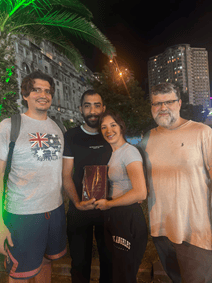
Yusuf and Amina (not their real names), seen in the centre of the picture, never dreamed of becoming heroes. They simply fell in love.
Love came quietly, the way spring comes after a long winter. It did not ask which family they belonged to. It did not care which of them was Sunni and which was Shia. It simply entered their hearts.
But reality proved stronger than human reason.
What would seem completely natural to most people became, for them, a source of mortal danger. Every meeting could have been their last. Every phone call made their hearts stop.
Every new day brought the same question:
“Will they find out today?”
For Amina, life at home became especially difficult. According to her, she lived in constant fear. Pressure, humiliation, and psychological trauma became part of everyday life. She stopped feeling like a daughter. She felt like a prisoner.
When a person lives in fear for long enough, they stop dreaming. They begin simply looking for a way to survive.
And one day, they made their decision.
There were no dramatic speeches and no beautiful promises. They simply took all the money they had managed to save over a long period of time—and ran.
That was how their journey into the unknown began.
They chose Georgia not because they knew the country and not because anyone was waiting for them there. They knew almost nothing about the place they were going. Georgia was simply one of the few doors still open to them.
They arrived with almost no belongings, no friends, no language, and little understanding of how life around them worked.
They believed that surely the adult world would help two young people once they heard their story.
But the world outside proved colder than they had expected.
They found work at a café by the sea. It was their first hope of staying afloat. Very soon, however, that hope disappeared. According to them, the job ended in disappointment, and nearly all their money was gone.
Every evening they came home with the same question:
“What will happen tomorrow?”
Sometimes despair does not arrive loudly. It simply sits down beside you. It makes you silent, drains your strength, and gradually convinces you that no one needs you.
It was at that moment that an Israeli married couple entered their story.
As devoted disciples of Yeshua of Nazareth, they had specifically been looking for a Christian woman to help care for their young child. That was how they came to meet Amina and Yusuf.
But what they found before them was not merely a young woman who could work as a nanny. They saw two human beings whom life had already wounded deeply.
And these Israeli believers decided not to pass them by.
For them, this was more than a decision to help two strangers. As disciples of Yeshua HaMashiach, they clearly recognized the instruction handed down to us by Luke in the parable of the Good Samaritan.
Sometimes faith begins precisely where calculation ends.
They opened a door to Yusuf and Amina—and with it, a door to hope.
Later, another serious problem arose.
In order to apply for political asylum, Yusuf and Amina needed official proof of their relationship as husband and wife. Returning home to register their marriage was impossible. It would have meant going back to the very place from which they had escaped with such difficulty.
In Georgia, however, they were able to marry quickly and completely legally.
For most people, marriage registration is simply a formality.
For them, it was about their future.
One more step toward a life without fear. One more possibility that someday they might wake up and realise that no one was coming after them anymore.
But their story did not end there.
It continues today.
And now we are seeing another side of their story—one that could never have been visible on the first day they met their new friends.
Waiting for political asylum, living with uncertainty, having no home of their own, and carrying constant stress and fear about the future gradually began to wear them down.
Recently, Amina ended up in the hospital.
The intense stress and anxiety had affected her heart. Thankfully, everything turned out well. The doctors carried out the necessary examinations, prescribed medication, and presented the newlyweds with a medical bill far beyond what they could afford.
During the examination, they discovered something else as well:
The Lord had created a new life within her.
Now, as an expectant mother, it is especially important for Amina to remain calm and recover.
I came to see them at the hospital and helped with her discharge and the medical bill. And it was there that I saw them in a way that perhaps no one hearing this story from a distance could fully imagine.
They were simply sitting together, holding each other.
Amina rested her head on Yusuf’s shoulder. She was exhausted and was simply trying to rest for a moment—perhaps even to fall asleep.
Yusuf sat beside her.
They demanded nothing from one another. They spoke no grand words.
They simply held on to each other.
Before me was not a romantic couple from some beautiful love story.
Before me were two deeply exhausted human beings.
Two people who had already endured so much.
Two people who had fled their homeland for the sake of love—and who now desperately need the support and love of God’s people as they begin a new life under the guidance and protection of our Lord.
And it was there that I found myself thinking about love once again.
Because their own love—the love for which they had once left their homeland—had led them toward something infinitely greater:
the love of God.
The love of Yeshua HaMashiach—Jesus Christ.
They are only beginning to understand how great that love truly is.
It is unlike human love.
It does not ask where you come from.
It does not look at your passport.
It does not count borders.
It does not keep a record of which nations once fought against one another.
Between Israel and Lebanon lies more than geography. Between the people of those countries stand years of hostility, pain, fear, and mutual distrust.
But where human beings see a border, Mashiach sees suffering and desperate human souls.
And then something extraordinary happens.
An Israeli married couple opens their hearts to a Lebanese family.
Then they introduce them to Carlos—an Arab Christian, an evangelical pastor who speaks Arabic, Hebrew, and English fluently.
Another border disappears.
Another wall becomes a door.
And gradually we begin to see how the loving hand of Mashiach is leading these people:
from fear to hope,
from loneliness to community,
from a foreign land to a new family,
from human love to the love of God.
Their love for one another once caused them to leave everything behind.
But now they are beginning to discover a Love immeasurably greater than their own.
The love of our Lord.
The love of Mashiach.
A love that does not merely capture the heart—it changes the way a person sees the entire world.
It almost takes your breath away.
Suddenly you realise:
God has not abandoned me.
Not even here.
Not even in a foreign country.
Not even when the world around me feels cold and it seems that no one cares what happens to me.
Today, Yusuf and Amina continue searching for a country that will receive them and grant them political asylum.
They are searching for a place where they can live without fear, work, build their family, and grow in faith.
They are looking for more than a roof over their heads.
They are looking for a home.
And perhaps that is why their story touches the heart so deeply.
Because each of us, at some point in life, has found ourselves in a place where the world suddenly became cold.
Where you were surrounded by people and yet felt completely alone.
Where you spoke, but no one seemed to hear you.
Where you searched for a door, only to watch one wall after another rise in front of you.
And it is precisely then that we begin to understand most clearly that the love of God can come to us through another human being:
through a hand extended at exactly the right moment,
through an open door,
through someone who simply says:
“I see you. You are not alone.”
This story is not finished yet.
It is being written right now.
We do not yet know where Yusuf and Amina’s next home will be, which country will become their safe refuge, or where the Lord will lead them.
But one thing is already becoming clear:
the loving hand of Mashiach is leading them.
Their story began with two people who chose love.
And now that love is leading them to the One who is Love Himself—Jesus Christ, our Lord and Savior, the blessed Messiah of Israel.
And perhaps that is why their story is no longer only the story of Yusuf and Amina.
Perhaps it is also a story about something much greater:
Even in a world where people continue building walls between nations, God continues building bridges.
And sometimes one human being becomes the Good Samaritan for another—the person through whom the Lord Himself says:
“I love you.”
=======================================================================
Contact Details
Steve Chappell , UK HLM Office,
On behalf of Holy Land Ministries
 Holy Land Ministries